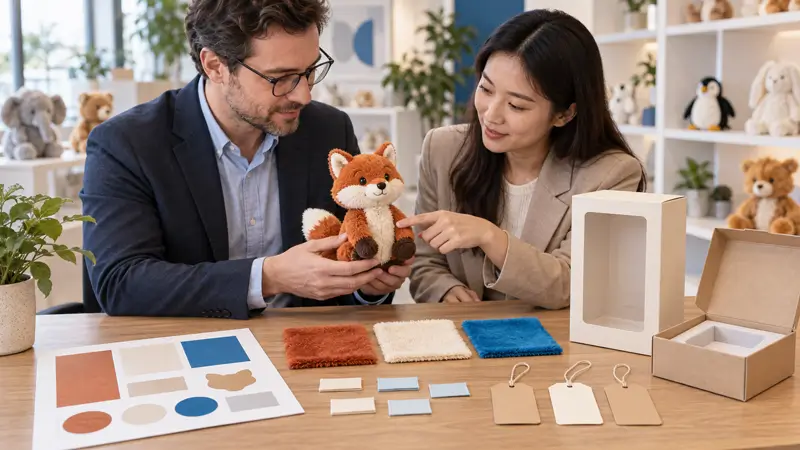
A private label toy project can involve a branded package, a different presentation of an existing product, or the development of an original plush character. These requests require different information, sample reviews and production arrangements.
Before asking for a quotation, define what needs to change and what can remain as it is. That helps buyers compare suitable options without assuming that every toy can be redesigned or decorated in the same way.
This guide explains the customization routes LINK BRAND can discuss, what buyers should prepare, and how to approve the product and packaging together.
Quick Answer: What Can Be Customized?
For LINK BRAND projects, plush toys can be considered for deeper development, including shape, size, fabric, embroidery and selected accessories. Other toy categories mainly involve product selection and confirmed private-label or packaging adaptations, assessed for each item.
Hangtags, labels, sleeves, retail boxes and gift packaging are possible project directions, subject to product suitability, supplier confirmation and order requirements. A packaging change does not mean the toy itself can be redesigned.
1. Choose the Right Scope for Your Project
Begin with the reason for customization. A retail brand may need consistent shelf presentation. A bank campaign may need a recognizable mascot. A corporate gift program may need several products presented as one coordinated set.
The scope should follow that purpose. Use the following routes to structure the discussion; these are planning categories, not standardized industry service levels.
| Project route | What it involves | When to consider it | What needs confirmation |
|---|---|---|---|
| Existing product with branded presentation | Selecting a suitable model and discussing tags, labels or packaging | A project where an available product already fits the purpose | Product availability, permitted branding and packaging quantities |
| Product and packaging adaptation | Reviewing selected changes available for a particular model, alongside its packaging | A project needing a more coordinated presentation | Feasible changes, sample requirements and supplier restrictions |
| Custom plush development | Developing an original plush design or adapting a plush brief in greater depth | Mascot, souvenir, promotional or merchandise projects | Artwork, construction, materials, sample revisions and final specification |
Start with the minimum set of changes needed to meet the brief. Add further changes when they have a clear purpose and can be supported by the project schedule.
Explore our private-label and product development options when deciding which route to discuss.
2. What Can Be Developed for Custom Plush Toys?
Plush development offers room to discuss the character and physical product together. A useful brief describes both the appearance and the intended application.
Shape and Proportions
Provide clear reference views showing the face, body, limbs and important details. Explain which features define the character and where the development team has flexibility.
A drawing is a starting point. The physical sample is where buyers review how those features translate into a three-dimensional toy.
Size, Fabric and Filling
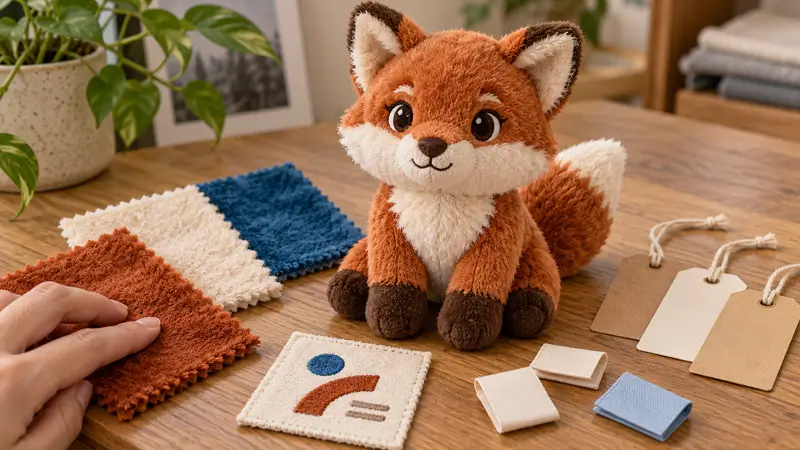
Specify how the size should be measured, including whether ears, tails or attachments are included. Share the preferred texture and feel through reference samples where possible.
Ask for proposed fabric and filling details to be recorded with the sample. If the product is revised, confirm whether the dimensions, shape or weight also need to be checked again.
Embroidery, Labels and Accessories
Faces, small symbols and selected decorative details can be discussed for embroidery or other suitable methods. Review fine details on the actual sample rather than relying only on enlarged artwork.
Clothing, ribbons, loops and other accessories need to be considered as part of the finished product. Identify which are essential to the concept and which are optional.
| Plush development area | Buyer input | Sample review focus |
|---|---|---|
| Character shape | Reference views and key visual features | Proportions and recognizability |
| Dimensions | Target measurements and intended use | Agreed measurement method and finished size |
| Fabric and colors | Texture references and color direction | Actual appearance and feel |
| Embroidery | Artwork and important details | Legibility, placement and execution |
| Filling | Desired shape and handling feel | Consistency across reviewed samples |
| Accessories | Purpose, position and attachment requirements | Complete product construction and suitability |
Our custom plush toy options can help you prepare an initial brief.
For a machine-prize application, include the equipment requirements at the start. Our guide to choosing plush toys for claw machines explains the physical review considerations for that use.
3. What About Squishy, Remote Control and Other Toys?
For non-plush categories, begin with the selected model and a written list of requested changes. Confirm each option before using it in a project proposal.
LINK BRAND's role for these products mainly involves selection, sourcing coordination and confirmed branding or packaging adaptations. We do not offer squishy toys as in-house manufacturing or OEM development.
Do not assume that an existing product can be resized, reformulated or fitted with different electronic components. Such requests need a separate feasibility review and may fall outside the available project scope.
If branding the product surface is not available, a suitable label, sleeve, insert card or package may still be considered. Its feasibility depends on the product, presentation requirements and supplier arrangements.
Compare the available wholesale toy categories first, then identify which changes are essential for the shortlisted items.
4. Select Branding That Suits the Product
Brand presentation can appear on the product, on an attached item, or on the packaging. Decide where it serves the project best before specifying the same treatment across an entire range.
| Branding direction | Possible role | What to review |
|---|---|---|
| Plush embroidery | Adds a character detail or approved brand element | Artwork detail, fabric, size and sample execution |
| Sewn label | Provides a compact identity element on a suitable textile product | Content, location, attachment and required information |
| Hangtag | Presents brand or product information | Attachment, dimensions, artwork and intended handling |
| Sleeve or insert card | Coordinates an existing package or gift set | Fit, layout, product visibility and necessary information |
| Printed box | Creates a broader retail or gift presentation | Artwork, construction, protection and product identification |
| Direct product decoration, where confirmed | Places an approved mark on a suitable selected model | Surface compatibility, available process and physical sample |
Separate decorative branding from required product information. A brand label does not automatically replace the labels or instructions needed for the selected product and destination.
For a mixed assortment, consistent colors and package design may create a coherent range even when individual items use different branding methods.
5. Match Packaging to the Channel
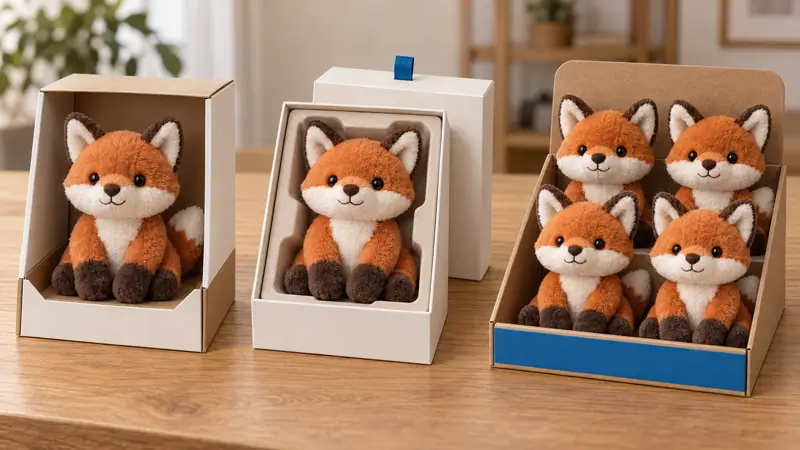
Packaging decisions should reflect how the toy will be displayed, transported and handed to the recipient. Review the product inside its intended pack before approving dimensions or artwork.
Retail Packaging
Discuss shelf or hook placement, visibility, pack dimensions and product identification. If a counter display is planned, confirm how many units it holds and how staff will replenish it.
Promotional and Gift Packaging
For campaign gifts, consider individual distribution, presentation and the space available for any accompanying message. A smaller pack may be useful for a large event, while a coordinated box may suit a selected gift program.
Multi-Product Sets
Check the arrangement of the complete set. Products can differ in shape, weight and protection needs, so approving each item separately does not establish that the finished box is ready.
GS1 US explains the distinction between a GTIN, which identifies a trade item, and the barcode that carries identification data. Its guide to GTINs and barcodes provides useful background for retail packaging discussions.
Confirm who supplies the identification data and who checks the final artwork before printing.
6. Understand What Changes the Quotation and Schedule
Ask the supplier to quote against a defined specification. The number of products, variants, decoration methods and packaging components can create separate requirements that need to be reviewed together.
Discuss the following items explicitly:
- Development work: Drawings, sample creation and agreed revisions.
- Product quantity: Units per design, size or color, not just the overall order total.
- Branding: The confirmed method, artwork and placement for each item.
- Packaging: Components, printing, assembly and packing quantities.
- Documentation: Required reviews or testing included in the project scope.
- Delivery: Packing details, destination and the quotation's freight basis.
There is no single MOQ or lead time for every private label toy project. Obtain written confirmation for the selected product and packaging combination.
Work backward from the required arrival date and allow time for review decisions. If artwork or samples remain unapproved, confirm the effect on the schedule before treating a delivery date as fixed.
7. Approve the Product, Artwork and Packaging Together
A digital mockup helps discuss position and appearance. Physical samples allow buyers to review the finished product, decoration and packaging fit.
Use an approval record that identifies the version being accepted and any unresolved items. If the sample uses temporary fabric, a substitute accessory or unprinted packaging, make that limitation explicit.
| Approval area | What to check | What to record |
|---|---|---|
| Product | Model, dimensions, colors, construction and function where relevant | Approved specification and sample reference |
| Branding | Artwork version, method, position and actual execution | Final artwork and agreed tolerances where applicable |
| Labels and information | Product identity, required content and intended market | Responsible reviewer and approved files |
| Packaging | Fit, presentation, protection and complete contents | Pack specification and reference photos |
| Carton arrangement | Quantity, assortment and identification | Packing instructions by SKU or set |
| Open issues | Any difference between sample and proposed production | Required correction and approval status |
The Toy Association's toy safety resources provide industry background and links to further information. For the actual project, confirm the relevant product and destination-market requirements and the documentation needed for the finished version.
Keep the approved sample, artwork and packing instructions together as the production reference.
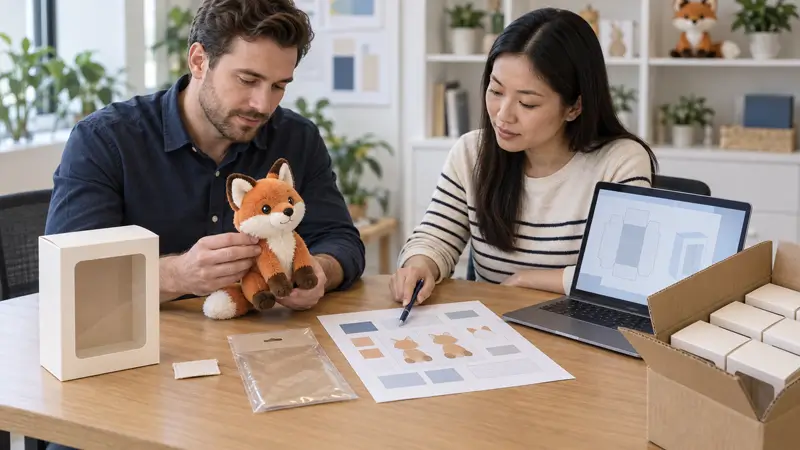
8. Prepare a Clear Private Label Project Brief
A useful brief tells the sourcing team what the product needs to achieve, which decisions are already fixed and which options are still open.
| Information to prepare | What to include |
|---|---|
| Application | Retail, prizes, souvenirs, bank gifts, corporate gifts or another defined use |
| Audience and market | Intended users, age group and destination country |
| Product direction | Existing model reference or original plush concept |
| Required changes | Essential changes and optional preferences |
| Artwork | Logo or character files, reference views and permission to use supplied assets |
| Dimensions and materials | Target size, texture references and color direction |
| Quantities | Units by design, size and color; expected repeat orders |
| Packaging | Retail, individual gift, counter display or multi-product set |
| Budget | Target range and what it should include |
| Timing | Required arrival date and availability for sample decisions |
| Documentation | Project-specific information and review requirements |
When several products are involved, first decide the role of each item. Our guide to planning a toy assortment for your sales channel explains how to organize that selection.
Example: One Campaign, Two Possible Routes
Imagine a bank preparing a customer gift campaign. If the goal is coordinated campaign presentation, the buyer could discuss a suitable existing product with an approved branded tag or package. If the goal is to turn an original mascot into a recognizable plush gift, a custom plush development brief would be more appropriate.
The first question is what the campaign needs to communicate. The next questions are feasibility, quantities, samples and timing. This is an illustrative comparison, not a customer case or a promise of availability.
Frequently Asked Questions
Can every toy be customized with our logo?
No universal option applies to every model. The product surface, construction and supplier's available processes need to be checked. Where direct decoration is not offered, suitable packaging or attached branding may be discussed instead.
What is the difference between private label and custom plush development?
In this guide, private label presentation starts with a selected product and confirmed branding or packaging options. Custom plush development allows a deeper discussion of the toy's shape, materials, dimensions and details. Confirm the actual scope rather than relying only on a service name.
Can LINK BRAND develop a new squishy shape or material formula?
LINK BRAND does not offer squishy OEM development. For squishy projects, start with available product selection and confirm any feasible private-label or packaging adaptation for the chosen item.
Can we order several toy categories with coordinated packaging?
A coordinated project can be discussed, but feasibility must be confirmed for each product and the finished set. Review component quantities, packaging fit, sample requirements and delivery coordination before approval.
Is there a standard MOQ for private label toys?
MOQ depends on the selected product, variants and packaging requirements. Request a quotation that identifies quantities for each design or component instead of assuming one overall minimum applies to the complete project.
Do we need a physical sample if the artwork is approved?
Artwork approval confirms the selected file and layout. A physical sample helps review the product, actual decoration and packaging fit. Agree what the sample represents and record any differences still awaiting confirmation.
Discuss Your Private Label Toy Project
Share your application, product references, artwork, estimated quantity, packaging needs and required arrival date with LINK BRAND. We can help review the project scope, discuss suitable plush development or confirmed branding options, and coordinate the next steps.