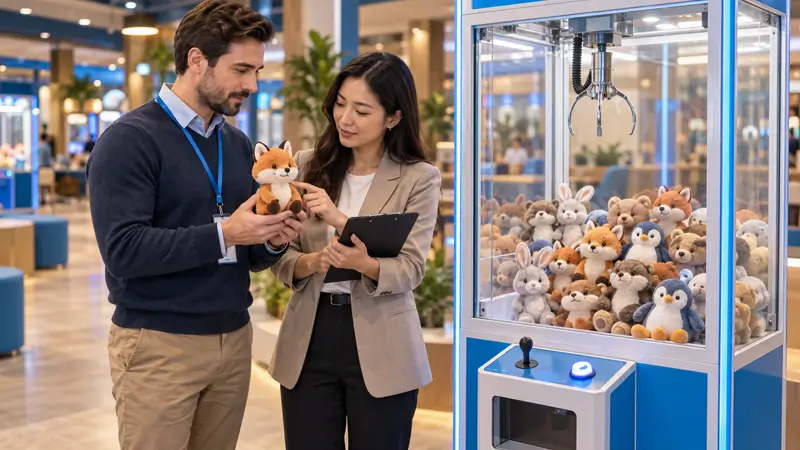
A plush toy can look appealing in a catalog and still be unsuitable for the machine where it will be used. Its body dimensions, weight, shape and accessories all need to be reviewed alongside the cabinet and the operator's setup.
Choosing plush toys for claw machines starts with a clear machine brief and ends with a physical sample review. For bulk buyers, the decision also includes presentation, product documentation, packing and consistency between repeat orders.
This guide provides a practical selection process for arcade operators, family entertainment centers, distributors and buyers preparing claw machine prize programs.
Quick Answer: How Do You Choose Suitable Claw Machine Plush?
Start with the machine model and its manufacturer's prize guidance. Compare the full dimensions and weight of each plush sample, check its shape and attachments, and review how it looks inside the cabinet. Have the operator evaluate shortlisted samples in the intended machine before approving a bulk order.
There is no single plush size or weight that suits every claw machine. The product and machine need to be assessed together.
1. Start With the Machine, Not the Catalog Size
Send your sourcing partner the machine make and model, photos of the prize area, and any relevant manufacturer guidance. If you already use a suitable prize, provide its reference, dimensions and weight as a comparison point.
Record the usable prize area and the prize outlet, rather than relying only on the external cabinet dimensions. Include the claw configuration specified for that machine and any limits identified by its manufacturer or service provider.
For a multi-location program, group machines by model and configuration. One approved sample does not automatically establish compatibility across a mixed fleet.
| Information to collect | How it helps the shortlist |
|---|---|
| Machine make, model and configuration | Identifies the equipment for which samples will be reviewed |
| Manufacturer's prize guidance | Provides machine-specific limits and setup instructions |
| Usable prize area and outlet dimensions | Helps identify potential space and delivery-path issues |
| Current suitable prize reference | Gives buyers and suppliers a physical comparison point |
| Photos of normal loading | Shows the intended presentation and surrounding products |
| Intended audience and market | Guides theme selection and product-documentation review |
If specifications are incomplete, ask the machine supplier or service provider to clarify them before approving product quantities.
Our claw machine prize solutions provide a starting point for discussing the product shortlist and replenishment requirements.
2. Compare Full Dimensions, Weight and Shape
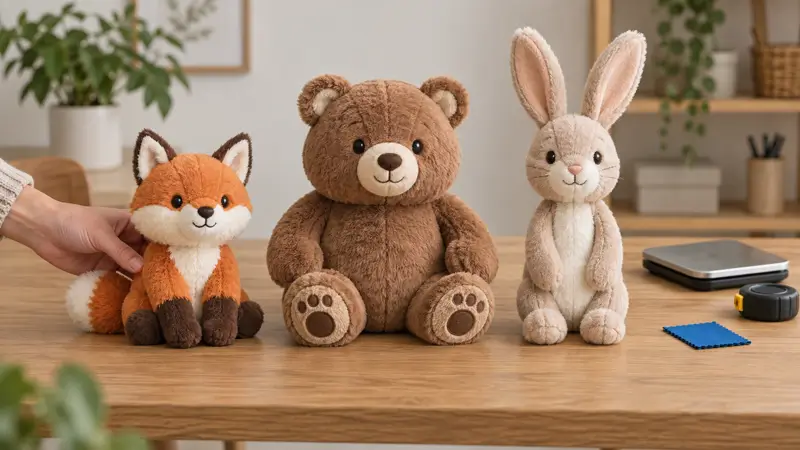
A catalog description such as “20 cm plush” leaves questions unanswered. Does the measurement include ears, a tail or a hanging loop? Is it measured sitting, standing or laid flat?
Ask for a consistent measurement method. Record the sample's main body height, width and depth, its overall dimensions including projections, and its unit weight. Include accessories in the weight when they will remain attached during use.
Body Proportions Matter
Two toys with the same listed height can have different body widths or depths. A broad seated animal and a narrow upright character should therefore be compared as separate shapes.
Look at the sample from the front, side and above. Identify long limbs, large ears, hard accessories or loose loops that need specific review in the intended machine.
Weight Needs Context
Record weight as a comparison variable rather than assuming the lightest item is the best choice. Products with similar outer dimensions may use different filling amounts, fabrics or accessories.
Ask the supplier to state the proposed weight range and discuss acceptable variation. Check more than one sample where possible so the review is not based on a single unusually light or heavy unit.
Keep the Comparison Consistent
| Attribute | What to record | Question for sample review |
|---|---|---|
| Dimensions | Body dimensions and overall dimensions | Is the measurement method clear and repeatable? |
| Weight | Finished unit weight, including retained accessories | Are sample differences acceptable for this machine program? |
| Shape | Body profile, projections and balance | Does the complete shape work in the intended setup? |
| Filling | Firmness and distribution observed in samples | Do samples retain a consistent shape after unpacking? |
| Attachments | Tags, loops, ribbons and hard parts | Could an attachment interfere with normal handling or delivery? |
Use these observations to narrow the range before asking for a larger sample set.
3. Choose a Plush Format That Fits the Program
Different plush formats create different questions for the buyer. Use the following comparison to organize a shortlist, then validate it against your actual machine.
| Plush format | Reason to consider it | What to check |
|---|---|---|
| Compact animal plush | Offers a recognizable theme in a smaller format | Body dimensions, sample weight and visibility inside the cabinet |
| Seated animal plush | Creates a clear character pose | Width, depth and how the pose changes when handled |
| Rounded or cushion-style plush | Provides a broad visual surface | Full volume, surface material and behavior in the sample trial |
| Plush keychain | May suit a small-prize program where approved | Ring, loop and tag interference; machine suitability |
| Custom mascot plush | Connects the prize with an original brand or venue character | Development brief, sample revisions and final machine review |
These are evaluation directions, not a list of universally compatible prize types. In particular, a plush keychain should not be treated as interchangeable with a plain plush toy: the attachment changes the complete product.
Explore our plush toy options to discuss existing product directions or a custom development brief.
4. Review the Display From the Player's Position
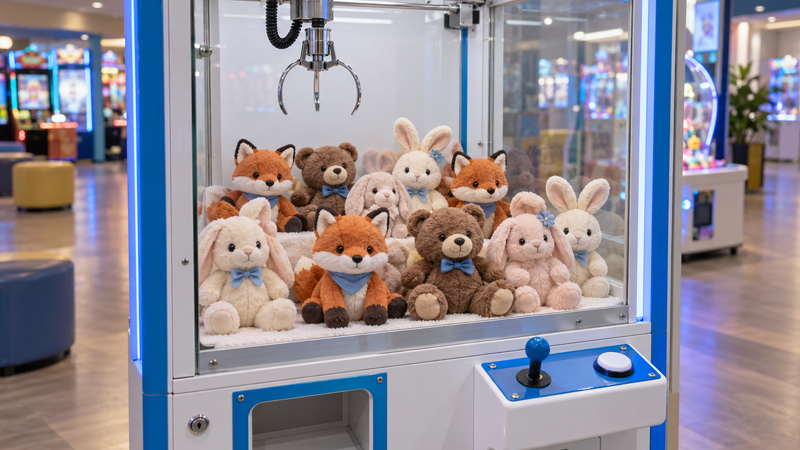
Photograph the proposed range through the cabinet glass under its normal lighting. Check whether the faces, shapes and color differences are still clear from where a player stands.
Assess a manageable theme group first. Original animals in a coordinated palette can be easier to compare than a large collection of unrelated designs. The aim is to give the display a clear identity while preserving useful choices.
Consider these questions during the review:
- Can a viewer identify the main characters without reading a tag?
- Are faces or distinctive features hidden by the normal arrangement?
- Does the cabinet background make some colors difficult to distinguish?
- Can staff reproduce the approved display when replenishing stock?
- Does the arrangement stay within the machine manufacturer's loading guidance?
Keep reference photos of the approved presentation. If the loading arrangement changes substantially, ask the operator to review it again with the same products.
For broader venue operations and industry learning, IAAPA's family entertainment center resources provide additional context. They do not replace the instructions for a particular machine.
5. Inspect the Finished Toy and Its Documentation
Review the product as it will be supplied. Look at seams, embroidery, fabric condition, filling distribution, tags and accessories. Compare front and back views with the approved sample and artwork.
A visual inspection helps identify workmanship differences, but it does not establish that a toy meets all requirements for its destination market. Confirm the intended age group, product specification and required documentation with the parties responsible for the order.
The Toy Association's toy safety resources offer industry background and links to safe-play information. For a specific shipment, review the applicable requirements and documentation for the selected product and destination.
If a shipping bag is removed before loading, distinguish it from labels or attachments that must remain with the toy. Agree the handling process in advance rather than allowing staff to improvise at each location.
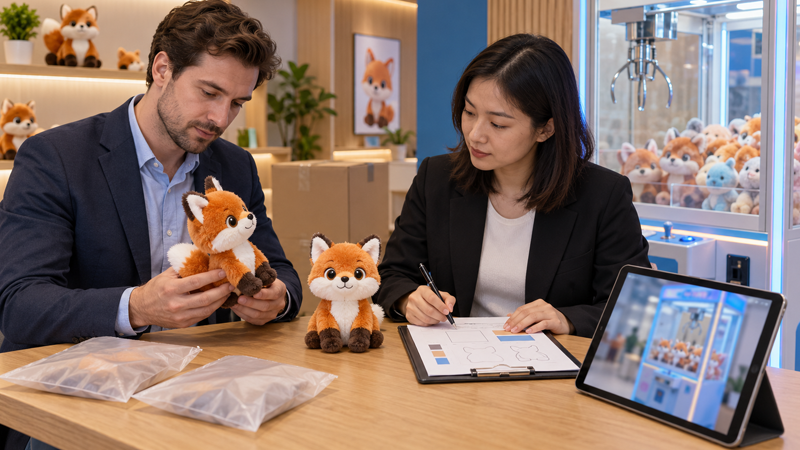
6. Run a Documented Sample Trial
A sample trial should be organized by the operator using the intended machine and its manufacturer's instructions. The purpose is to evaluate compatibility, presentation and handling before committing to stock.
The following is a proposed purchasing review, not a laboratory test or an industry certification protocol.
- Identify each sample. Record the SKU, dimensions, weight, accessories and packing condition.
- Record the equipment. Note the machine model and the operator-approved configuration used for the review.
- Prepare the normal display. Use a loading arrangement that follows the equipment guidance and represents the intended operation.
- Observe multiple positions. Review the sample across relevant positions and orientations, recording the number of observations and the conditions.
- Follow the complete path. Observe pickup, movement and delivery through the outlet; note obstruction, snagging or product damage if it occurs.
- Compare samples consistently. Keep conditions comparable when evaluating different products. Record any setup change and its reason.
- Approve, revise or reject. List the issue to resolve and repeat the relevant review after a product change.
| Review item | Record | Decision |
|---|---|---|
| Product fit | Dimensions, shape and outlet observations | Accept, revise or reject |
| Attachments | Any snagging or interference observed | Confirm attachment design or handling changes |
| Presentation | Photos under normal cabinet lighting | Approve the display or adjust the shortlist |
| Product condition | Before-and-after sample observations | Investigate damage or construction concerns |
| Repeatability | Results across samples and recorded conditions | Identify whether more review is needed |
| Final specification | Approved sample reference and changes | Freeze the order specification |
Do not convert a short sample trial into a promised player win rate. Its findings apply to the recorded samples, equipment and conditions.
Keep the approved sample and trial record together so later deliveries can be compared with the same reference.
7. Plan the First Order and Replenishment
Once the shortlist is approved, define the quantity for each design and variant. Separate core products intended for repeat orders from limited seasonal or trial designs.
Confirm minimum quantities by SKU, carton contents, reorder conditions and expected availability. A total order quantity alone does not establish that every requested color can be supplied in any proportion.
Packing also needs review. If compressed packing is proposed, inspect samples after unpacking under an agreed recovery process and check their restored shape before cabinet approval. Do not assume a fixed recovery time or freight saving without product-specific evidence.
For deliveries to several locations, discuss carton identification and whether each carton should contain a ready-to-use mix. Clear packing instructions can make receiving and replenishment easier to organize.
Our guide to planning a toy assortment for your sales channel explains how to assign product roles and balance variety with stock depth.
8. Confirm Custom Plush Changes Before Production
For an original venue mascot or brand character, define the intended machine application at the start of development. A change to the head, limbs, fabric, filling or accessories may require another physical review.
LINK BRAND can discuss deeper plush development, including shape, size, fabrics, embroidery and selected accessories. The final design should be approved as a complete product for its intended use.
Review private-label and product development options when preparing artwork, branding and packaging requirements. Keep revision records so the production specification matches the final approved sample.
Bulk Order Checklist for Claw Machine Plush
| Information to prepare | What to provide |
|---|---|
| Equipment | Machine make, model, configuration and relevant manufacturer instructions |
| Machine photos | Prize area, outlet and normal loading arrangement |
| Product references | Preferred designs and a current suitable prize, if available |
| Dimensions and weight | Measurement method, full dimensions and proposed weight range |
| Audience and destination | Intended users, age group and destination market |
| Quantities | Units by design and color; initial and expected repeat orders |
| Branding | Original artwork, embroidery, labels and approved attachments |
| Packing | Bagging, compression proposal, carton contents and location labels |
| Sample approval | Trial observations, approved reference and unresolved changes |
| Delivery | Destination, required arrival date and approval milestones |
If you do not yet have a complete brief, start with machine photos, the model, your preferred product direction and estimated quantities. Identify missing information before final approval.
Frequently Asked Questions
What size plush toys should I buy for claw machines?
Use the manufacturer's prize guidance for the specific machine, then compare full sample dimensions and the delivery path. A listed height alone is not enough to establish compatibility. Review the actual product in the intended setup before ordering in bulk.
Are lightweight plush toys always better?
Weight is one part of the assessment. Shape, dimensions, attachments and the equipment configuration also need review. Record the finished weight and compare physical samples instead of choosing solely by the lowest weight.
Can plush keychains be used as claw machine prizes?
They may be considered where the machine supplier and operator find them suitable. Review the ring, loop and tags as part of the complete product, including possible interference during normal handling and delivery.
Can I mix different plush sizes in one machine?
Only approve a mixed range after evaluating it in the intended machine and loading arrangement. Compatibility of one product on its own does not establish compatibility of every combination. Keep a record of the approved mix.
What should I confirm before a repeat order?
Compare the proposed order with the approved sample and specification. Confirm dimensions, weight range, fabric, filling, accessories, packing and availability. Review substitutions before shipment rather than treating a similar appearance as an identical product.
Discuss Your Claw Machine Plush Project
Share your machine model, cabinet photos, destination market, preferred designs, estimated quantity and required arrival date with LINK BRAND. We can use your brief to discuss a plush shortlist, customization needs and supply coordination, while machine compatibility is confirmed through the operator's sample review.