

A supermarket shelf, an FEC prize counter and a corporate gift campaign can all use toys, but they need different product assortments. The display space, recipient, budget and replenishment pattern change what makes a product suitable.
Toy assortment planning means deciding which products to carry together, how much to order of each, and how the mix will work in its intended setting. A useful plan connects product selection with packaging, stock levels and delivery requirements before an order is placed.
This guide explains how to build that plan for retail, distribution, redemption prizes, souvenirs and gift programs.
Quick Answer: What Makes a Useful Toy Assortment?
Start with the sales channel or application, define the audience and budget, then give each product a clear role. Choose a manageable range of product types and price levels, check the packed products against the display or distribution method, and agree how replenishment will work.
The right mix is specific to the project. A retailer may need several price points and repeat orders. A fixed-date gift campaign may need one coordinated product delivered in the full required quantity.
1. Start With the Channel and the Buying Occasion
Before reviewing product photos, describe where the assortment will be used and what the buyer or recipient should be able to do with it.
A distributor also needs to consider the downstream channel. An assortment intended for supermarket customers may differ from one supplied to small gift shops, even when both orders come through the same importer.
| Channel or application | Main planning question | Product directions to assess | Operational checks |
|---|---|---|---|
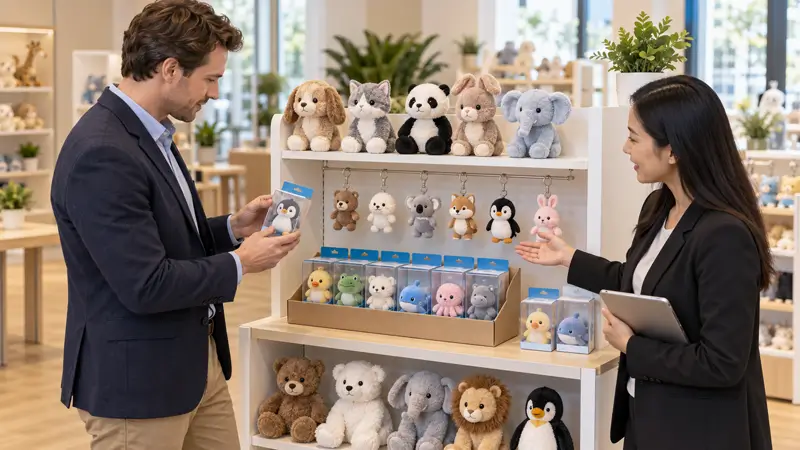
| Supermarkets and retail stores | Will shoppers understand the choice, price and product at the display? | Compact toys, plush, puzzles and selected novelty items | Shelf or hook space, packaging, product identification, case packs and replenishment |
| Importers and distributors | Can downstream buyers order and reorder the range efficiently? | A focused selection matched to customer channels and price levels | Per-SKU quantities, order units, carton contents and repeat availability |
| FEC redemption counters | Does the range provide meaningful choices across the operator's ticket levels? | Small prize items, medium plush and selected display prizes | Operator-approved ticket values, stock depth, display space and replacement options |
| Theme parks and zoo shops | Does the product connect with the visit and travel home easily? | Original animal-themed plush, plush keychains and coordinated souvenir ranges | Theme consistency, carrying size, packaging and seasonal demand |
| Corporate, bank and event gifts | Does the item fit the audience, message and distribution plan? | Mascot plush, small gifts or selected toy-based sets | Branding scope, individual packing, recipient quantities and arrival deadline |
These are starting points for evaluation, not fixed product prescriptions. Review the shortlist against the intended age group, market and actual product specifications.
For retail and distribution projects, our supermarket, distributor and brand toy solutions provide a starting point for discussing channel requirements.
2. Define the Audience, Budget and Practical Limits
A brief becomes more useful when it includes constraints. Record the destination market, intended users, expected order quantity, available display space and required arrival date.
Budget should also be defined consistently. A target product purchase price is different from a retail selling price or a budget that includes packaging and delivery. State what your target includes so shortlisted products can be compared on the same basis.
For gift programs, consider both the person approving the order and the person receiving the product. A procurement team may prioritize consistent packing and on-time delivery, while recipients need an item that fits the occasion and is straightforward to use or carry.
Age suitability needs to be reviewed for each shortlisted product. The Toy Association's toy safety resources provide industry background and links to safe-play information. Use the relevant destination-market requirements and product-specific documentation when reviewing an actual order.
3. Give Each Product a Clear Role
An assortment is easier to manage when each item has a reason to be included. Consider four practical roles:
- Entry options: Products that provide an accessible starting price or, for redemption programs, a lower ticket requirement set by the operator.
- Core options: Products expected to carry regular demand and justify attention to stock depth and repeat availability.
- Feature options: Items selected to add a distinctive theme, larger visual presence or higher-value choice.
- Trial or seasonal options: Products introduced for a limited period or tested before a larger commitment.
One item may have more than one role. A seasonal plush can be a feature product, for example. The purpose is to make the buying decision clear rather than force every SKU into a rigid category.
There is no universal allocation that works for every channel. Use sales history, redemption records or campaign quantities where available. For a new range, define what will be reviewed after launch before increasing the order.
For FEC redemption prize planning, agree the prize levels with the operator. Product purchase cost alone does not determine a suitable ticket value.
4. Balance Variety With Stock Depth
Variety gives customers a choice, but every additional model, size or color also creates another stock decision. A wide selection with very little availability per item can be difficult to replenish and present consistently.
Start by separating assortment breadth from stock depth:
- Breadth: How many distinct products or variants are offered.
- Depth: How many units are held or ordered for each one.
For each proposed SKU, ask what it adds. Does it serve a different price level, audience, theme or use? If two items fill the same role, compare them directly before buying both.
Also check minimum quantities and packaging order units at the SKU level. A supplier's overall order minimum does not automatically mean any mix of colors or products is available within it.
An Illustrative Small-Display Plan
The following six-SKU example shows how to document product roles. It is a planning illustration, not a LINK BRAND customer case, a sales forecast or a recommended ratio.
| Proposed SKU | Role | Why it is included | Check before ordering |
|---|---|---|---|
| Animal plush keychain | Entry | Adds a compact hanging option | Hook fit, attachment, packed dimensions and quantity |
| Small original animal plush | Core | Offers a clear theme at a modest display size | Sample finish, shelf footprint and repeat availability |
| Medium plush in the same theme | Feature | Adds a visible size choice | Display height, purchase cost and packed volume |
| Compact puzzle | Core | Introduces a different play format | Intended age group, instructions and retail packaging |
| Selected squeeze toy | Trial | Tests a tactile product direction | Material specification, packaging and handling needs |
| Seasonal plush accessory | Seasonal | Connects the display with a defined selling period | Arrival date and remaining-stock plan |
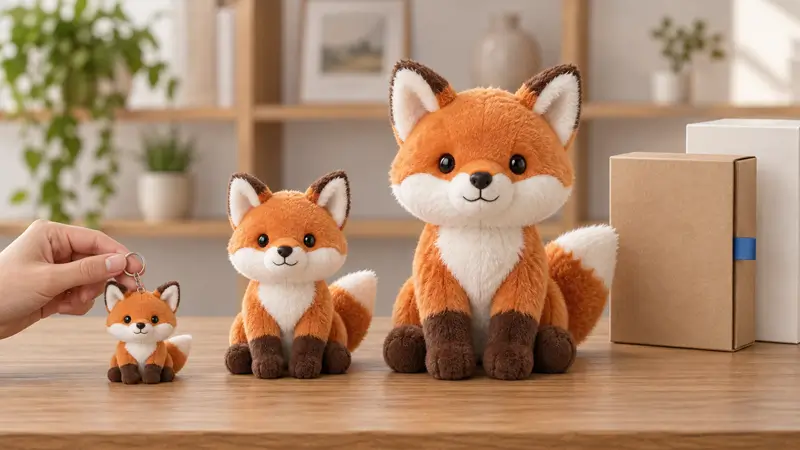
Order quantities should be added after checking display capacity, demand assumptions, per-SKU minimums and the next feasible replenishment date.
Our wholesale toy categories can help identify initial product directions for a shortlist.
5. Plan Packaging and Display Before Final Selection
Review products in the form in which they will be sold, displayed or distributed. A loose sample can fit a shelf while its retail box does not. A gift can look compact on its own but require a larger protective pack.
For a retail assortment, confirm the usable shelf dimensions, hanging arrangement or counter-display footprint. If a PDQ counter display is planned, review the filled display, the number of units it holds and the effort needed to replenish it.
For a prize counter, consider how products will be seen and retrieved. For gifts and souvenirs, consider the carrying experience and whether an individual bag or box is needed.
Product identification should be agreed before packaging artwork is finalized. GS1 US explains that a GTIN identifies a trade item and distinguishes the identifying number from the barcode that carries it. Its guide to GTINs and barcodes is a useful reference when discussing retail identification with your trading partners.
Confirm who supplies identification data, who checks the artwork and which packaging levels the buyer needs to identify. Do not use placeholder barcode artwork as production-ready information.
6. Match Branding Ambitions to the Product
Brand consistency can come from coordinated colors, hangtags, packaging or a shared theme. The feasible method depends on the selected product and project requirements.
For LINK BRAND projects, plush toys can be discussed for deeper development, including shape, size, fabric, embroidery and selected accessories. Other categories mainly involve product selection and confirmed private-label or packaging adaptations. Availability is assessed for each item; squishy products are not offered as LINK BRAND in-house manufacturing or OEM development.
A mixed-category project may therefore use different branding methods across its products. Review the finished items together to check that the range feels coherent without assuming every product can accept the same decoration.
Our private-label options explain the project directions that can be discussed before sampling.
7. Build Replenishment Into the First Order
For an ongoing range, the first order should include a plan for what happens when individual products run low.
Record the expected reorder lead time, minimum reorder quantity and carton configuration for each core item. Ask whether colors, materials or packaging could change between orders, and identify any alternatives that would need buyer approval.
Keep trial products separate in your review. Decide in advance what evidence would justify another order: sales by SKU, redemption activity, customer requests or a clear operational benefit. Where a product is not performing, check placement, availability and price before assuming that a new design is the answer.
A fixed-date campaign needs a different approach. Confirm recipient quantities, a reasonable project-specific allowance where needed, and the full delivery schedule. Replenishment may have little value once the event has ended.
8. Approve the Assortment as a Complete Project
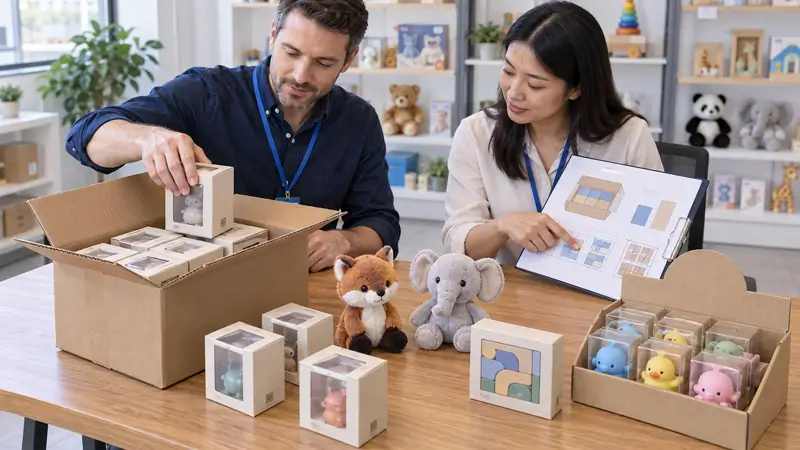
Individual samples should be reviewed together with the proposed packaging and assortment list. Compare what has been approved with what will be ordered, packed and delivered.
A final review should cover:
- Product references, sizes, colors and quantities by SKU.
- Sample observations and any agreed corrections.
- Branding artwork and the confirmed method for each product.
- Individual packaging, display configuration and carton contents.
- Required product documentation and responsibility for review.
- Delivery destination, required arrival date and approval milestones.
- Reorder conditions or the campaign's remaining-stock plan.
Record decisions in a shared specification or approval sheet. If a substitution is proposed later, review its effect on the whole assortment, including packaging and display fit.
Toy Assortment Planning Checklist
Use the following brief to prepare a discussion with your sourcing partner.
| Information to prepare | What to include |
|---|---|
| Channel and application | Retail, distribution, redemption prizes, souvenirs or a specific gift program |
| Market and audience | Destination country, intended users and intended age group |
| Project objective | New range, regular replenishment, seasonal update or fixed-date campaign |
| Budget | Target range and what the amount includes |
| Product preferences | References, desired themes, sizes and functions |
| Quantities | Initial quantity by SKU or a clearly marked estimate |
| Display or distribution | Shelf dimensions, hooks, counter display, prize wall or individual gift distribution |
| Branding and packaging | Artwork, tags, boxes, displays and identification requirements |
| Timing | Required arrival date and time available for sample approval |
| Repeat orders | Expected reorder pattern and acceptable changes, if any |
If some information is not yet available, identify the decisions that remain open. A clear brief can start with an application and constraints before exact products have been selected.
Frequently Asked Questions
How many SKUs should a new toy assortment include?
There is no fixed number. Start with the products needed to cover the main buying choices within your budget and display space. Check that each SKU adds a useful role and that its minimum quantity leaves enough stock depth for the rest of the range.
Can one assortment work for retail stores and FEC prize counters?
Some products may be suitable for both, but the full assortment needs separate review. Retail pricing, packaging and identification differ from an operator's prize levels, display method and redemption pattern. Confirm each channel's needs before placing a combined order.
Should every item carry our logo?
That depends on the project and selected products. Packaging, tags or a coordinated theme may provide sufficient brand consistency. Confirm decoration options for each item and review samples before approving the complete range.
How often should we update the product mix?
Set the review schedule around sales or redemption data, seasonality and replenishment lead times. Keep useful core products under review while testing additions at a manageable scale. A monthly review does not require replacing products that still fit the channel.
Discuss Your Toy Assortment With LINK BRAND
LINK BRAND supports commercial buyers with product selection, assortment planning, plush customization, confirmed private-label options and delivery coordination.
Explore our toy assortment planning support or share your channel, market, quantity, budget and required arrival date. We can use that information to discuss a suitable product shortlist and the next project steps.